What does sustainability mean to us?
For us, sustainability means making conscious decisions, using materials and resources as sensibly as possible, and continually looking at where we can improve.
As a small family business, we cannot avoid every impact our products may have. But we can decide which materials we use, how we package and ship our orders, how we handle returns and whether a product really needs to be replaced.
For us, that is what responsible use of resources means.
Choosing materials consciously
For our SmartShell hard cases, we use polypropylene (PP) with a proportion of recycled PP and natural wheat-straw fibres.
The SK-BIO01 material used has been tested by Intertek for biodegradability under defined anaerobic conditions according to ASTM D5511-18.
It is important to us to explain these material properties transparently and realistically. On our page Materials & biodegradability, we explain in detail what our hard cases are made from, what exactly has been tested and which disposal route we currently recommend.
Plastic only where it is useful and necessary
We do not believe it makes sense to reject plastic in general. In products such as a protective phone case, it performs important functional tasks: the material needs to be lightweight, stable, retain its shape and work well in everyday use.
Our approach is therefore to use plastic where its properties are genuinely needed – and to avoid it where suitable alternatives are available.
For our shipping packaging, we therefore use no plastic packaging materials.
Less paper in shipping
We send invoices digitally.
We do not include printed delivery notes.
We also do not automatically include a return label with every order if it may never be needed.
This helps us use paper and packaging materials only where they are actually required.
Fair return costs instead of spreading them across everyone
Returns are part of online shopping. However, we do not believe the costs of returns should automatically be spread across all orders.
That is why our customers do not all indirectly pay for returns that are only used by some.
When a return is necessary, the corresponding return costs are assigned to that specific return.
For us, this is a fair solution: customers who do not return an order do not have to cover those costs through higher prices.
Avoiding returns when they are not necessary
When handling complaints, we also try to avoid unnecessary transport.
If we can reliably assess damage from photos, we do not automatically require the defective product to be returned.
This helps us avoid return shipments that provide no additional benefit in resolving the case.
Repairing when it makes sense
Not every defect automatically means that a product needs to be replaced.
Where a repair is practical and reliable, we recommend it before replacing the product.
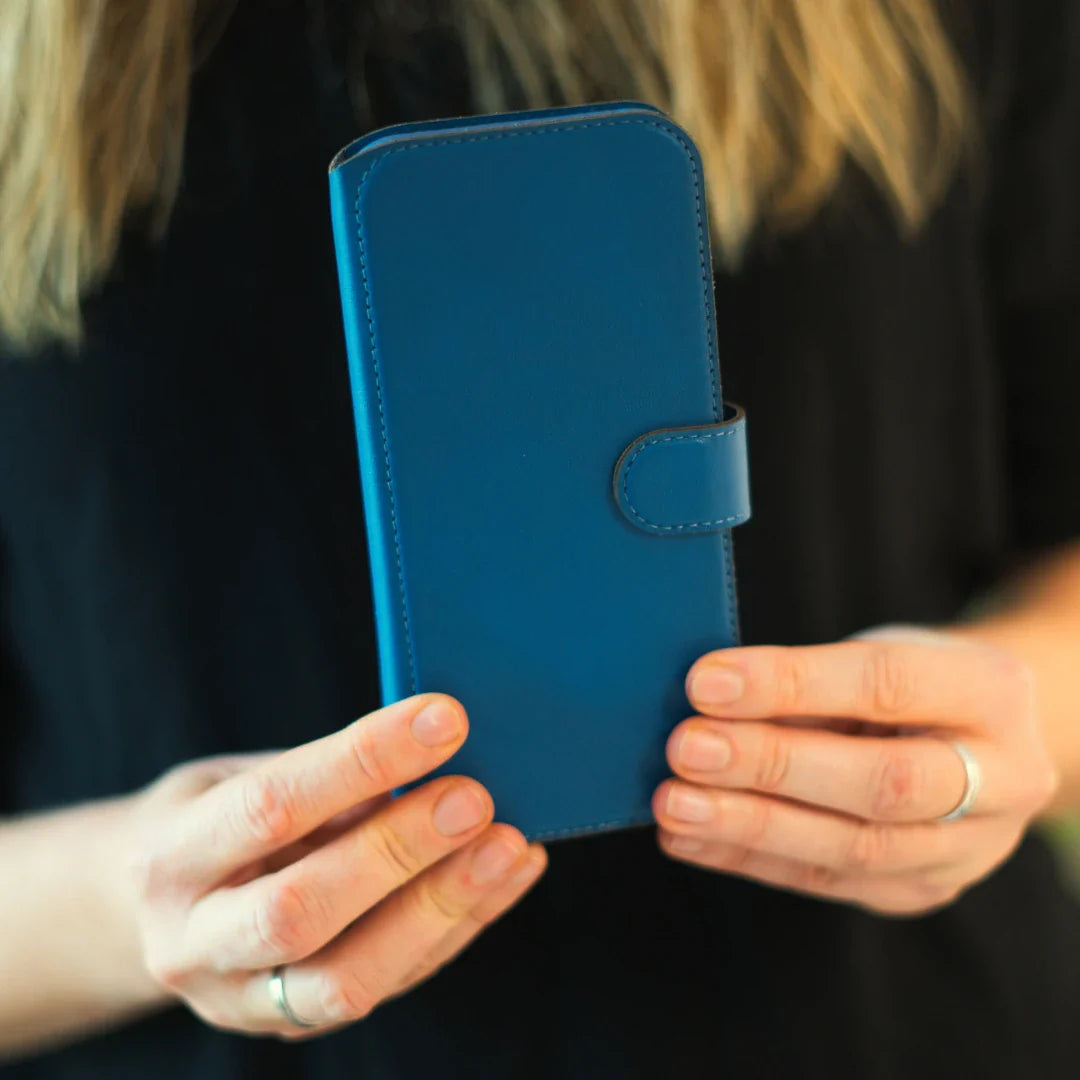
With our leather flip covers, for example, loose bonded areas can often be reattached easily, allowing the cover to continue being used.
For products where repair is not technically practical, we will of course look for another suitable solution.
Shipping with DHL GoGreen Plus
We use DHL GoGreen Plus for our shipping.
GoGreen Plus reduces greenhouse-gas emissions through additional measures within DHL’s logistics network. These include, among other things, alternative fuels, electric trucks and electrically powered delivery vehicles.
The emission reductions are allocated to GoGreen Plus shipments through a so-called Book & Claim system. This does not mean that every individual shipment is transported exclusively using these technologies. However, the emission-reduction measures take place within the DHL network.
Supporting marine conservation
Biowaves supports the marine conservation organisation SPOT in Cyprus.
We currently sponsor two sea turtles.
Through this support, we contribute to SPOT’s work protecting and researching sea turtles and their habitats.
For us, this support is not a compensation measure for our products. It is a project that matters to us personally and that we support independently.
Many concrete steps instead of big promises
We are a small family business. Not every decision is perfect, and there is not yet an ideal solution for every challenge.
That is why we prefer to show transparently what we actually do: when choosing our materials, in packaging and shipping, in how we handle returns and in deciding whether a product should be repaired or replaced.
We continue to develop these decisions as materials, technical possibilities and collection and recovery systems evolve.